
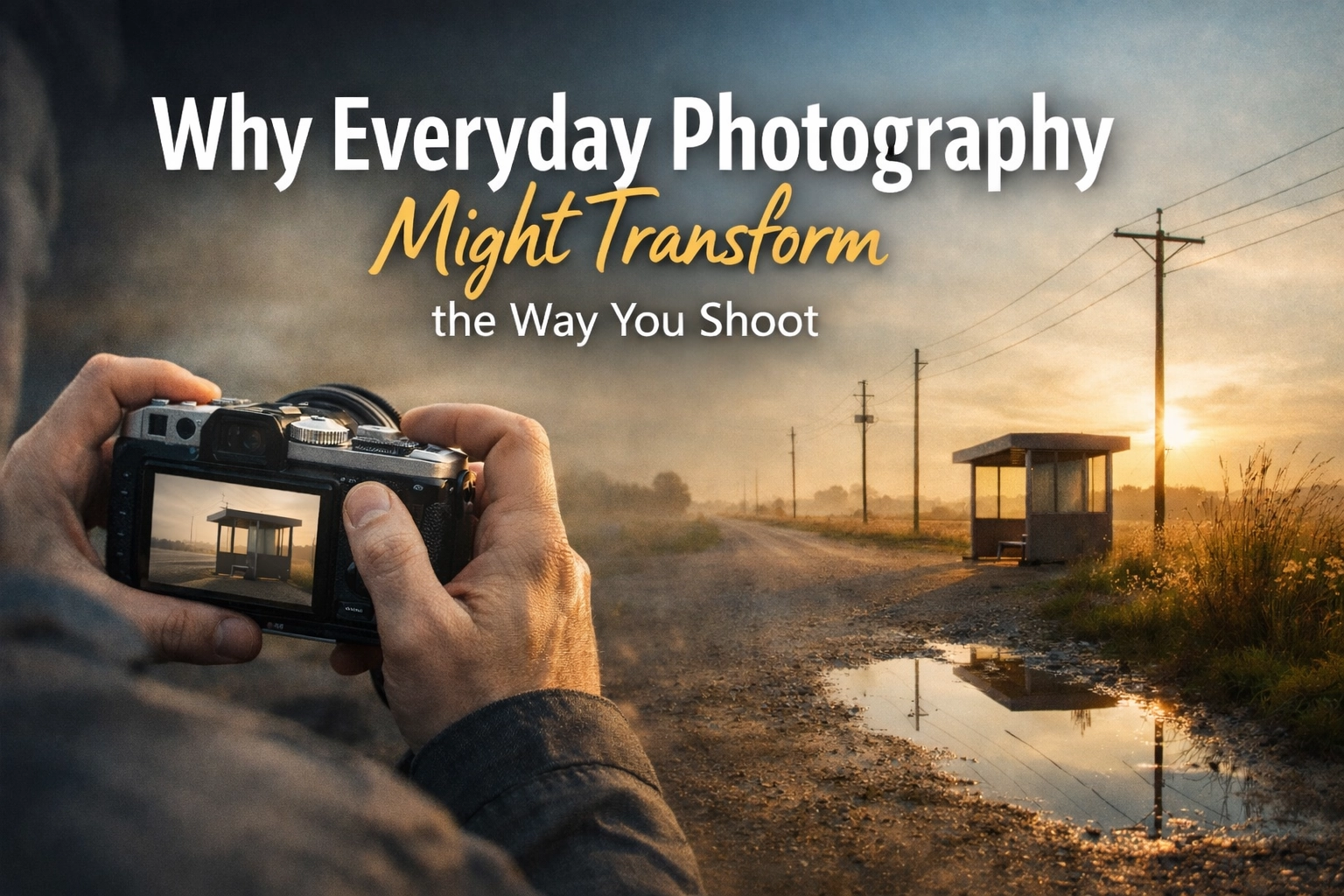
What If Everyday Photography Is the Key to Becoming a Better Photographer?
What if becoming a better photographer has less to do with traveling somewhere spectacular and more to do with paying attention to what is already nearby?
Many photographers believe their best images are waiting in dramatic landscapes, famous cities, or bucket-list destinations. Mountains, coastlines, and iconic streets often seem like the places where meaningful photography happens.
But what if growth happens somewhere else entirely?
What if the fastest way to improve is through everyday photography — photographing the ordinary streets, fields, buildings, and quiet corners most people overlook?
What If Ordinary Subjects Teach Better Composition?
When photographing naturally beautiful places, the location often provides instant impact. A grand mountain range or glowing sunset already carries emotional weight.
But everyday photography works differently.
A gravel road, empty bus stop, weathered shed, or plain backyard doesn’t rely on spectacle. Those scenes demand stronger choices from the photographer. They require attention to:
- Light
- Shadow
- Geometry
- Negative space
- Framing
- Mood
Without a dramatic subject doing the heavy lifting, composition becomes the true focus.
What if photographing ordinary scenes trains the eye faster than photographing epic ones?
What If the Background Matters More Than the Subject?
Many forget that a photograph is rarely just about the object in the frame. It is also about everything surrounding it.
A chair on a beach can feel uninteresting when tightly framed. But step back and include empty space, clouds, weather, and distance, and the image can suddenly communicate solitude, stillness, or longing.
That is one of the hidden lessons of everyday photography.
It teaches that supporting elements often create the story:
- Atmosphere
- Context
- Space
- Texture
- Contrast
- Environment
What if the most important part of a photo is not the subject, but the world around it?
What If Gear Matters Less Than People Think?
Photography culture often encourages the belief that improvement comes through upgrades:
- Better sensors
- More megapixels
- Sharper lenses
- More dynamic range
But everyday photography can challenge that mindset.
Ordinary scenes do not require the most expensive camera to become meaningful images. A shadow on a wall, fog over a field, or lines in a parking lot can be photographed with almost any capable camera.
What matters more is often simplicity — having gear that is enjoyable to carry and easy to use.
What if progress comes not from owning more equipment, but from using what is already available more often?
What If Not Every Photo Needs to Stand Alone?
Many photographers chase a single dramatic image — the photo that instantly grabs attention.
But everyday photography can encourage a different way of thinking.
Instead of searching for one masterpiece, it invites photographers to build collections of images that work together. A road, a fence, a doorway, a patch of farmland, and a quiet building may feel simple alone. Together, they can create mood, identity, and narrative.
What if photography is less about creating hit singles and more about building albums?
What If Everyday Photography Keeps Creativity Alive?
Most people cannot constantly travel to dream locations. Work, responsibilities, budgets, and routine get in the way.
That makes everyday photography valuable.
It allows photographers to keep practicing between major trips or special opportunities. It keeps visual instincts active and sharp. It turns routine places into creative training grounds.
What if photographing familiar surroundings is the best way to stay ready for extraordinary ones?
Because if compelling images can be made in a dull parking lot or flat field on a gray Tuesday, imagine what becomes possible in a stunning location.
What If Beauty Is Already Nearby?
Perhaps the greatest lesson of everyday photography is that meaningful images do not always require extraordinary places.
They may exist in:
- Morning light through a kitchen window
- Rain on a sidewalk
- Power lines against the sky
- Shadows across a fence
- Empty streets at dusk
- Quiet corners of a neighbourhood
The ordinary world is often ignored not because it lacks beauty, but because people stop noticing it.
What if the next great photograph is not waiting on a plane ticket or expensive trip?
What if it is already outside the door?

0 Comments